There are many kinds of partnerships that are used to enhance public education. The public private partnerships described here are those which involve the public school district partnering with private for-profit or non-profit developers for mutual benefit.
The case studies described here involve private entities entering into agreements with the school district to use public land to build private developments.
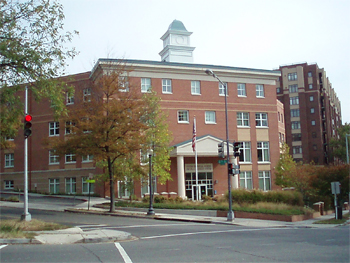
In the case of Oyster Elementary School, the private development is a market rate apartment building. The ongoing benefit the District of Columbia Public School System receives from this development is the repayment of the bond which paid to construct the new Oyster School on a portion of the original school site.
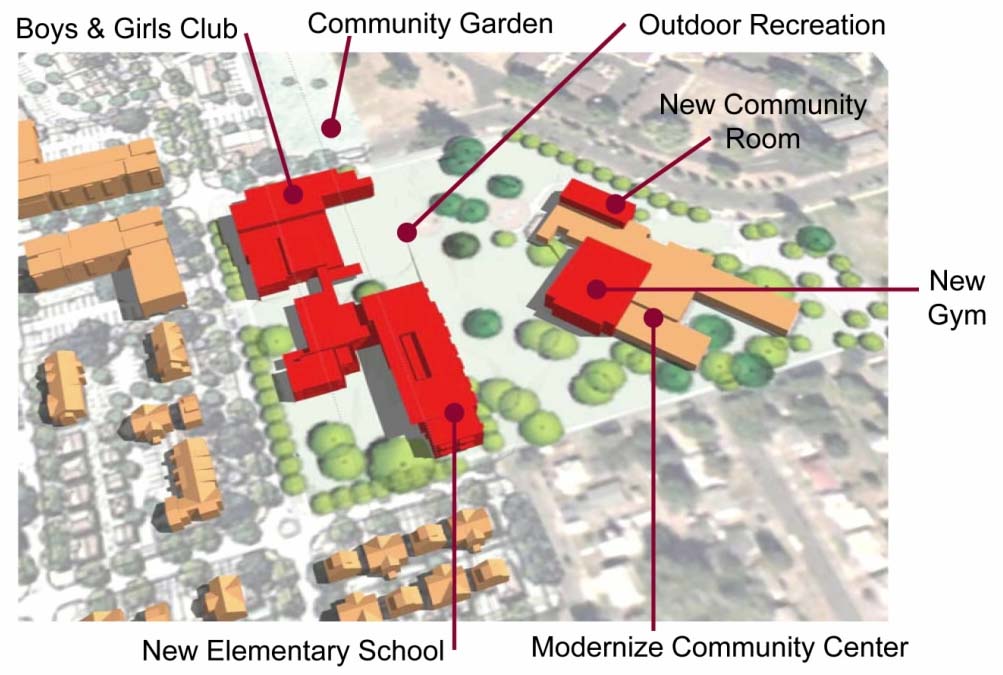
In the case of John A. Johnson Elementary School, the YMCA added a pool and community center onto the old John A. Johnson School, as part of its modernization. The ongoing benefit the St. Paul, Minnesota Public Schools receives is shared use of the community center.
This innovative practice area is under development.
Innovative Examples
Search:
for
A Public Private Partnership to Reopen
Public Schools in New Orleans -- [ abstract]
The New Orleans Public School System and the State Recovery District have a daunting task before them. Their task involves reopening damaged public school facilities in New Orleans and restoring public education throughout the city. But it is not enough to reopen or rebuild buildings; they need to improve the overall quality of public education in the city while giving all students access to high quality public school programs and buildings.
There are four major challenges involved with accomplishing this task. First, there is the overall challenge of improving quality of public education in New Orleans. Secondly, there is the challenge of repairing and rebuilding damaged public school facilities so they support high quality programs and services and schools as centers of community. Thirdly, high quality public school facilities have to be affordable to the State of Louisiana and the New Orleans Public School System. Lastly, the State and New Orleans Public Schools need the capacity to manage the planning, design and construction needed to reopen high quality public school facilities.
This proposal addresses these challenges associated with the reopening of public schools in New Orleans. The proposal recommends a public and private partnership to plan, design, construct, manage and finance the redevelopment of high quality public schools in New Orleans and the State of Louisiana damaged by Hurricanes Katrina and Rita.
Centennial Place Elementary School -- Georgia[ abstract]
Centennial Place is a 900 unit, mixed-income housing development in Atlanta, Georgia. Centennial Place Elementary School is a K-5 magnet school that shares space with the local YMCA. Developers worked with representatives from the Atlanta Public School board to replace the older elementary school with a new school at a different site within the community. Financing for the new school was supported by contributions from the Atlanta YMCA and the Atlanta Public School System. Representatives from Georgia Tech University, the Coca Cola Corporation, Bank of America, Bell South, the YMCA, and All Saints Episcopal Church served as partners for this project.
John A. Johnson Achievement Plus Elementary School -- Minnesota[ abstract]
The John A. Johnson Achievement Plus Elementary School is a renovated community school located in the Payne-Phalen neighborhood of Saint Paul, Minnesota. The 111,000 square foot school opened in 2000 and serves students in grades K-6. It is connected to a new YMCA facility which is used by students at the school for gymnasium space. The conjoined YMCA has a full size lap pool, pre-school, and aerobics studio available for student and resident use.
The lead developer for the Johnson School renovation was the Saint Paul Public school system. The primary partners for this project were the YMCA of Greater Saint Paul, the East Side Neighborhood Development Company, the Amherst Wilder Foundation, and Saint Paul city government and Ramsey County.
Oyster Bilingual Elementary School -- District of Columbia[ abstract]
The James F. Oyster Bilingual Public Elementary School building in Washington, D.C., was overcrowded, deteriorating and poorly supported the school’s nationally acclaimed English/Spanish dual language immersion program. Built in 1926, the school did not have appropriate space for instruction. After-school program offices were squeezed into converted closet space and neighborhood organizations had no access to the school for meetings, recreation, or other community uses.
The 21st Century School Fund, working with the Oyster Community Council (OCC, the school’s PTA), the Local School Restructuring Team, then-principal Paquita Holland and neighborhood residents, found a creative solution — a public-private partnership among the community, the government and the private sector — that saved the school and increased city revenue. This solution is unusual — but can be repeated in other urban communities.
Rosa Parks School and Community Campus at New Columbia -- Oregon[ abstract]
The Rosa Parks School in Portland, Ore., was planned, designed, constructed and financed as part of a mixed-use, public-private partnership. It is nestled in New Columbia, Oregon’s largest low-income housing revitalization area. The school serves grades K-5 and acts as the focal point for the Community Campus at New Columbia. There, services are offered that target literacy, nutrition and health, and early childhood, adult and senior development. After one year of enrollment at Rosa Parks School, students’ test scores placed them among Oregon’s top performing students.
Partners who assist in making these services and the public-private partnership possible include: Regence Boys & Girls Club, Portland Public Schools, Housing Authority of Portland, Parks & Recreation Community Center and The Corp of Discovery.
The University of Georgia School of Design & Planning Laboratory -- Georgia[ abstract]
The University of Georgia’s School of Design & Planning Laboratory offers courses and services which focus on the educational facilities planning for public and independent school systems as well as public agencies.
Turning Vacant Buildings into Schools -- North Carolina[ abstract]
BPLW Educational Planning Professionals and Wake County Public Schools (Raleigh, North Carolina) explain why vacant facilities are an untapped resource in the local community. Case studies are used to present benefits and challenges to using vacant "big box" stores, churches, and museums as schools.


 abstract]